
A household slicer may seem like a simple kitchen tool, but it can accurately cut a piece of frozen meat into thin slices of controllable thickness. Behind it is actually the coordinated action of a series of precise mechanical principles.
Understanding the core structure of a slicer—the blade, motor, and safety mechanisms—will not only help you use and maintain it more efficiently, but also help you make more informed decisions when purchasing one. This guide will break down these key components and reveal how they work together.
1. Blade: The core of cutting
The blade is the heart of the slicer, but its working principle is not just “cutting”. It is a high-speed rotating disc that completes the task by continuously shearing.
How it works: When you push frozen meat along a slide toward the rotating blade, the blade’s edge sweeps across the meat’s surface at an extremely high speed. This high-speed motion generates a powerful shear force , rather than simply downward pressure. It’s this unique shearing action that allows the blade to effortlessly sever the meat’s fibers, resulting in a smooth, even cut.
Key factors: Blade sharpness and cleanliness are crucial. A dull blade won’t cut effectively and will only tear the food. Residue on the blade will increase friction and affect the smoothness of the cut.
2. Motor: The Heart of Power
The motor is the engine of the slicer, which is responsible for driving the blade to rotate at high speed. There are two common motor transmission methods for household slicers:
Belt-Driven:
How it works: The motor drives the blades via a belt. Like a bicycle chain, the belt transfers the motor’s power to the blades.
Advantages: relatively simple structure, low cost and less noise.
Disadvantages: Belts will wear and age over time, which may lead to reduced power transmission efficiency or even slippage.
Gear-Driven:
Working principle: The motor drives the blade directly through a set of gears.
Advantages: Power transmission is more direct and efficient, providing greater torque and easily handling harder ingredients. Its durability is also far superior to belt drive.
Disadvantages: higher cost and relatively loud noise during operation.
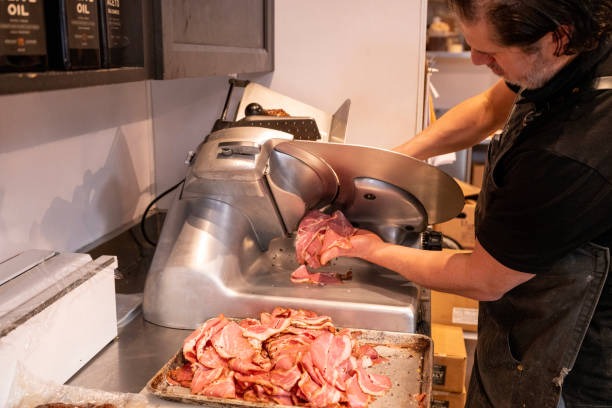
3. Safety devices: uncompromising guardians
The high-speed rotation of the slicer blade brings huge safety hazards, so a series of safety devices on the machine are crucial.
Food slide and hand guard: This is the most basic safety guarantee. The slide not only allows you to push the food smoothly, but the hand guard on it also isolates your hands from the sharp blades.
Safety switch and lock: Many slicers are designed with a safety switch that requires two steps to activate, such as pressing the safety button first and then turning on the power. This effectively prevents accidental activation of the machine.
Adjustable thickness guard: In addition to controlling slice thickness, this guard also serves an important safety function. When the thickness is adjusted to zero, the guard fits perfectly around the blade, hiding its sharp edge and making cleaning and storage safer.
Non-slip pads: The suction cups or non-slip pads at the bottom of the machine can firmly fix the slicer to the table, preventing it from moving due to vibration or uneven force during operation, ensuring the stability of the workbench.
Summarize:
By understanding the core structure and working principle of the slicer, you will not only be able to use it better, but also know your kitchen tools like an expert.
