
When it comes to buying a slicer, you can feel overwhelmed by the sheer number of options available. How can you tell which machine is truly worth your money? Don’t be fooled by flashy looks and a long list of unnecessary features.
A truly outstanding slicer is defined by three core, non-negotiable elements: performance, safety, and durability. If a model falls short in these three areas, don’t waste your time.
1. Blade: The heart of the machine
The blade is where the slicer performs its magic, and its quality directly determines the precision and consistency of your slices.
Blade Material: Look for high-quality stainless steel blades . It’s the industry standard because it resists rust and corrosion. Some higher-end blades are made of hardened steel or chrome-plated carbon steel. These blades will stay sharp longer but may require more careful maintenance to prevent rust.
Blade Size: For most home users, a blade between 7.5 and 9 inches is the best choice. Larger blades can handle larger roasts more efficiently, while smaller blades are good for occasional use. Any blade smaller than 7 inches may struggle to handle entire cuts of meat.
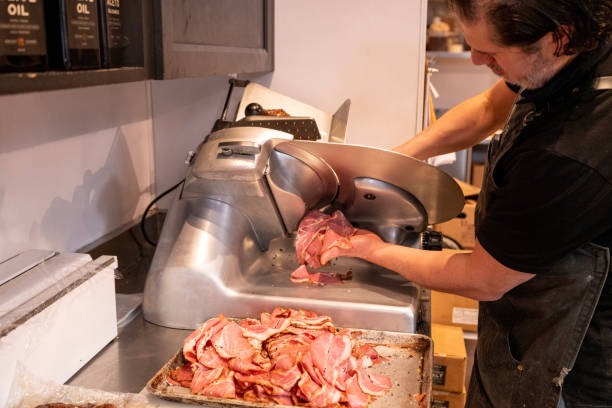
Blade type: Blades come in two main types: smooth and serrated . Smooth blades are best for creating clean, even slices of meat, cheese, and vegetables. Serrated blades are better for bread or crusty roasts. Most home slicers come with smooth blades, making them the preferred choice for perfectly sliced deli meats.
2. Motor power: cutting muscle
The motor is the engine of your slicer. A weak motor will struggle, stall, cause uneven slices, or even burn out prematurely.
Wattage (W): This is the primary measure of power. For everyday home use, a slicer with a 100-200W motor is generally sufficient. If you plan on slicing large quantities of dense, hard foods, like ham or hard cheese, look for a model with a wattage in this range or higher.
Motor type: This is the key to distinguishing between basic models and durable models.
Belt-drive motors are common in budget models. They’re quiet and inexpensive, but belts can wear and slip over time, causing a loss of power.
Geared motors are commonly found in higher-end residential and commercial models. They are slightly noisier, but offer direct power transmission, are more efficient, and are more durable.
3. Security features: a non-negotiable list
Safety is paramount when handling sharp blades. Never compromise on this aspect.
Stable food slides: The slides that carry food must be stable and have hand guards that can firmly grip the meat. This is crucial to protecting your hands.
Safety lock: A good slicer should have a safety switch or lock to prevent the blade from being activated accidentally. This usually requires a two-step process to activate the blade.
Non-slip feet: The bottom of the slicer should have strong suction cups or rubber feet to prevent the machine from sliding while slicing.
Removable blades and guards: For easy and safe cleaning, the blades and guards must be removable. You should be able to wash all parts without getting your fingers near sharp edges.
Summarize:
By focusing on these three core elements—blade quality, motor power, and its built-in safety mechanisms—you’ll be able to confidently navigate the market for a meat slicer that will serve you for years to come.
